
From 600 daily emails to company-owned operational intelligence
Precise Imaging processes referrals, lien requests, medical records, billing questions, appointment updates, patient documents, and a long tail of operational edge cases. We helped them automate the work and retain the knowledge, so every reviewed workflow can make the company smarter over time.
The situation when we first met
When Precise Imaging first reached out, their challenge was straightforward: volume. Over 600 emails landing in their inbox every day. Referrals, lien requests, medical records, billing questions, appointment updates, patient documents, and edge cases that did not fit neatly into a standard queue.
Their support staff were spending a good chunk of their day on routine tasks, which meant less time for the cases that genuinely needed human attention. Response times had stretched longer than they wanted, and they knew there was a better way to handle the workload.
The point was never just automation. The point was a learning loop.
At Possible Minds, our founding belief is that the most valuable AI systems do not just complete tasks. They create loops where human expertise and AI capability compound over time. Human judgment sets the direction. AI scales the execution. The learning loop compounds the expertise.
For Precise, that means reviewed emails become durable operational IP. When a human marks an email for AI training, the system preserves the conversation, the correct human-approved labels, the AI's original decision, and the trace of how that decision was made. If the AI was right, that becomes validation. If it was wrong, that becomes training signal.
Over time, those examples improve the company's private rules, evals, and workflow intelligence. The knowledge does not disappear into a generic model or walk out the door when someone leaves. It becomes company-owned intelligence that can survive model changes, software changes, and team changes.
The solution: two products, one unified approach
We tackled the problem in two phases, deploying a pair of AI systems that work together to cover both real-time and asynchronous patient communication while keeping the operating knowledge inside Precise's own system.
A voice-enabled chatbot embedded on their website, handling patient inquiries 24/7 with secure access to appointment data and seamless handoff to staff when needed.
Learn more →AI-powered email triage that reads, tags, routes, and drafts responses for 600+ daily messages—with smart document handling for liens and records requests.
Learn more →The results after both phases
Here's what changed after deploying both the AI chatbot and email automation together:
Combining chat and email automation handled the bulk of routine inquiries automatically.
That's over 4 full-time employees worth of work redirected to complex patient cases.
Down from 4-6 hours on email and missed after-hours chats. Patients get answers fast.
Faster answers, consistent responses, and 24/7 availability transformed the experience.
Reduced overtime, faster resolution cycles, and fewer escalations.
Patients get help nights, weekends, and holidays—no extra staffing.
AI responses consistently match staff-approved language and protocols.
An AI assistant that sounds like your best staff member
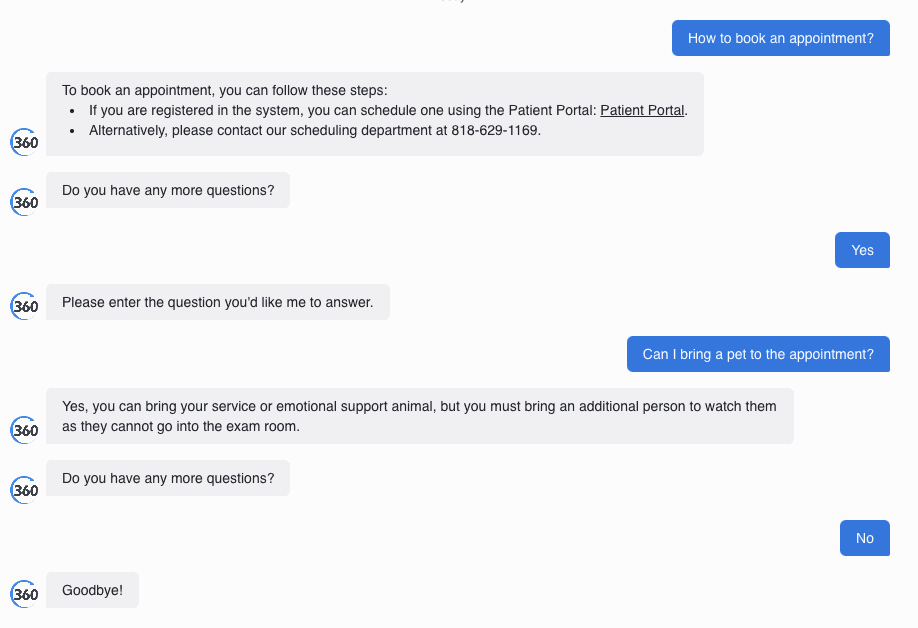
We started with the website. Patients were landing on their site at all hours—early mornings, late nights, weekends—and finding nobody to help them. The old chat widget was basically a contact form with extra steps.
We deployed an AI chat assistant trained on their specific services, locations, prep instructions, and policies. It doesn't just spit out generic answers. It knows the difference between their Glendale and Burbank locations. It knows which scans require fasting and which don't. It sounds like someone who actually works there—because we trained it on how their best staff members communicate.
Voice that actually works
Not everyone wants to type. Some patients—especially older ones—prefer to just talk. So we added voice. Real-time speech recognition, natural responses, and the same knowledge base powering the text chat. Patients can ask questions out loud and get spoken answers back, just like talking to a receptionist.
The voice system handles the back-and-forth naturally. It understands accents, handles interruptions, and knows when someone's finished speaking. It's not the robotic voice assistant people dread—it's conversational.
Secure access to real patient data
Here's where it gets interesting. Patients don't just want generic information—they want to know about their appointment, their results, their balance. But healthcare means HIPAA, and HIPAA means you can't just hand out patient data to anyone who asks.
We built a secure verification flow. When a patient asks about their specific appointment or records, the system sends a one-time code to their phone via SMS. Once verified, they can access their information—appointment times, prep instructions, even past visit history. All logged, all auditable, all compliant.
- SMS verification through Twilio before any PHI is shared
- Real-time appointment lookups from their scheduling system
- Complete audit trail of every verification and data access
Seamless handoff when humans are needed
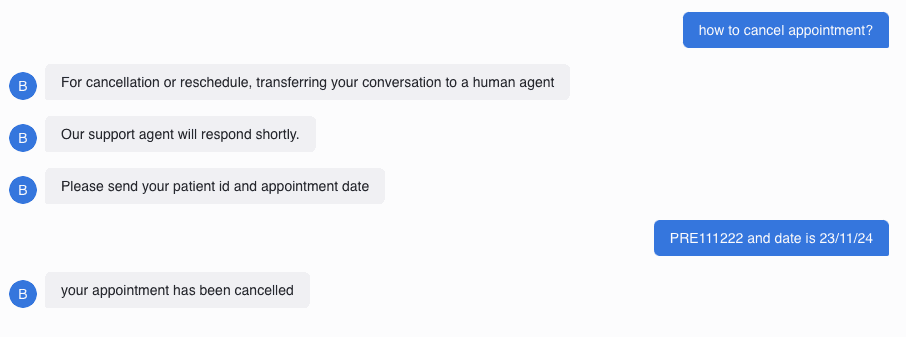
Not everything can be automated, and that's the point. When a conversation needs human judgment—a complicated scheduling conflict, a sensitive medical question, an upset patient—the AI knows to step back. It hands off the conversation to staff through FrontApp, complete with the full chat history and context.
Staff don't have to ask “what were you calling about?” They already know. The patient doesn't have to repeat themselves. It's a warm handoff, not a cold transfer.
Taming the email flood
The chatbot was working. Patient satisfaction on the website was up, and after-hours inquiries were finally getting answered. But the email inbox? Still a disaster. 600+ messages a day, and staff were spending hours just reading, sorting, and routing them before they could even start responding.
Phase 2 tackled email. We deployed EmailTag—our AI-powered email triage system—directly into their FrontApp inbox. Now, every incoming email gets read, understood, tagged, and routed automatically. Routine requests get drafted responses. Complex cases get flagged for staff with full context attached.
Just as importantly, the review process creates memory. When staff correct a label, approve a response, or mark a conversation for AI training, the system captures the example against the original AI decision. That gives Precise a growing private library of what good judgment looks like in its own operation.
Smart document handling
Medical imaging means paperwork. Lien documents from attorneys. Records requests from other providers. Faxes that somehow still exist in 2024. Most of these come as attachments, and reading them manually was eating up hours every day.
EmailTag doesn't just see an attachment—it reads it. OCR extracts the text. Barcodes get scanned for patient IDs and lien types. Signatures are detected and validated. If a document has been modified (strikethroughs, whiteout, alterations), the system flags it for review. Fraudulent or non-standard liens get caught before they cause problems.
Responses that sound right
Automated doesn't have to mean robotic. We worked with their team to build response templates for every common scenario—appointment confirmations, records release instructions, billing inquiries, lien acknowledgments. Each template uses their language, their tone, their specific policies.
When an email comes in asking about prep instructions for an MRI, the system doesn't just recognize the intent—it drafts a response with the right instructions for that specific scan type, personalized with the patient's name and appointment details. Staff can review and send with one click, or edit if needed.
That is the IP layer: not a generic answer from a generic model, but Precise's own tone, policies, exception handling, and routing logic encoded into a system the company can keep improving.
Better together
The real magic happened when both systems started working together. The chatbot handles website visitors and after-hours inquiries. Email automation handles the inbox during business hours. Both feed into the same CRM, so staff have complete context regardless of how a patient reached out.
A patient might start a conversation on the website chat at 10pm, get verified and check their appointment, then send a follow-up email the next morning asking to reschedule. The email system sees the chat history. It knows who this patient is. It can draft an appropriate response with the right scheduling options. No context lost, no patient repeating themselves.
What the staff actually think
Here's what surprised us most: the staff love it. We expected some resistance—“the robots are taking our jobs”—but instead we heard relief. The scheduling coordinator who used to spend her mornings just sorting emails now actually has time to call patients with complex cases. The billing team can focus on negotiations instead of answering the same balance questions fifty times a day.
One staff member put it simply: “I finally feel like I'm doing the job I was hired to do.” That's the goal. Not replacing humans, but freeing them to do human work.
What compounds next
This isn't a “set it and forget it” deployment. The system keeps improving based on real conversations and staff feedback. The knowledge base gets updated as policies change. New response templates get added as patterns emerge. Private evals and rules improve as the team reviews more edge cases.
Next on the roadmap: deeper scheduling automation (patients booking and rescheduling directly through chat), expanded SMS support for appointment reminders and follow-ups, and integration with their patient portal for even more self-service options.
Could this work for you?
If your team is spending more time sorting messages than helping patients, we should talk. Every healthcare organization is different, and we'll build a system that fits your workflows, your policies, and your patients while keeping the operational knowledge inside your company. No generic chatbots, no one-size-fits-all templates, and no lock-in to a single model or employee.